| |
Hungarian Weapons - Frommer Stop Pistols |
 |
275,000 Manufactured by Fegyver és Gépgyár Részvénytársaság, Budapest, 1912-18. ('Fegyvergyár' or 'F.G.GY.') 90,000 Manufactured by Fémáru Fegyver és Gépgyár Részvénytársaság, Budapest, 1919-29. ('Fegyvergyár' or 'Fémáru Fegyver és Gépgyár') Type: recoil operated automatic pistol Chambering: 7,65x17mm Frommer Long (=.32acp loaded hot), Frommer 9mm (.380acp loaded hot), 9mm Browning Short Overall length: 160mm [6.3"], height: 110mm [4.33"] Max. thickness: 22mm [.87"] Barrel: 100mm [3.94"] rifled, 4 grooves, right hand twist Depth of grooves: 0.135mm [.0053"], Width of rifling: 3mm [.12"] Weight with empty mag: 580g [20.5oz], Loaded: 634g [22.4oz] Removable magazine capacity: 7 rounds 7.65 cal. Bullet weight: 4.65g, Shell weight: 2.85g, Powder weight: .23g Muzzle velocity: 342m/s [1125 fps] (7.65x17mm Frommer Long cartridge) Max. penetration: 150mm [6"] thick pine board |
This Frommer design appeared in 1912 and was adopted by the Honvédség, (incorrectly called 'Honvéd'), the Hungarian element of the Austro-Hungarian Army. It's designation was 'Frommer Stop', it had no
model number. The international word 'Stop' meant 'to stop' the target. During WW1 the Frommer Stop pistols were also sold to Germany, Bulgaria and Turkey.
The designation '19.M' (Model 19) was given after it was adapted 'again' in 1919 by the new independent Hungarian Army and official Hungarian documents indicate that this is the correct model designation.
It subsequently became the official service pistol of the Hungarian army, police, gendarmerie and secret police. It remained in military and police hands until 1945, though theoretically, mostly in the Army, replaced by later models.
The Frommer Stop was a fresh approach to long recoil operation, the vital feature being a double spring system lying in a tunnel above the barrel. One
spring controls the movement of the bolt, while its companion absorbs the barrel recoil and returns the barrel to the firing position. This two-spring
system is implicit in any long recoil mechanism where barrel and bolt move independently. The springs surrounded the barrel and bolt in the
M1901 Frommer design, but placing them in the M1910 Frommer-type tunnel (though complicating
maintenance) made the gun much more compact. At the instant of firing, the Stop is locked by a rotating head on the two-piece bolt, similarly to the
M95 Mannlicher rifles. An inertia firing pin is struck by an external hammer, and the only safety device is a grip lever.
Barrel and bolt then recoil for about an inch to unlock the bolt. The bolt is then held while the barrel runs back, stripping out and ejecting the empty
case as it does so. The bolt is then released to run forward, chamber the fresh round, and rotate its head to lock the breech.
It is a functional, complicated design, required above average maintenance and was reportedly not popular with some of its users. However, with proper
care the pistols' long service life proved its critics wrong and most people loved them. Critics saying 'The complication of a long recoil system is
wasted on a relatively low-powered cartridge which can be handled by a simple blowback action' should check out the following ammo section.
 |
Ammunition: Original service pistols mostly chambered the 7.65x17mm Frommer Long cartridge (same dimensions as the .32acp, but loaded hot), some chambered the more powerful 9mm Frommer (.380acp loaded hot). Note: The pistol was designed for the 'hotter', more powerful 7.65mm and 9mm Frommer cartridges, so using standard .32acp is safe, but it may not result in a perfect operation. During the years popularity of the .32acp combined with the difficuties obtaining the original
7.65x17 Frommer Long cartridge lead to the common use of the .32acp in these pistols. This is the reason the use of .32acp 'stuck' with this pistol. It is also likely, that the exported 7.65 Frommers were commercially marketed
as .32acp. The original 9mm Frommer was also a 'hot loaded' version of the .380 acp cartridge. 7-round detachable box magazine shown on the left. Original mags stamped '7,65 FROMMER' (or '9 FROMMER'), but not serialized. |
7.65x17 Frommer Long: Bullet 70-80gr, - Muzzle Velocity 1075-1125, - Muzzle Energy 180-200
7.65x17 (.32ACP):     Bullet 60-72gr, - Muzzle Velocity 800-950,   - Muzzle Energy 115-145
There is an obvious difference, especially in Muzzle Energy.
 |
The Frommer Stop pistols bear an official proof mark on the left front side of the trigger guard. Commercial proofs: St.Steven's crown above the letters 'BP' (for Budapest), enclosed in a circle. |
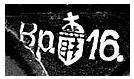 |
Military acceptance mark: 'Bp' (for Budapest), followed by the Hungarian crest and the last two figures of the year of manufacture. |
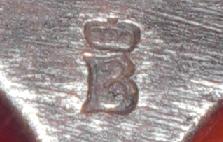 |
German Contract acceptance mark: crown over a gothic 'B' and/or 'D'. About 37000 Frommer Stop pistols were sold to Germany in 1916-17, between serial numbers 56000-93500. There are reports of German proofed pistols with random serial numbers up to 180000. |
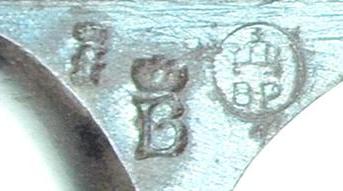 |
German Contract acceptance mark: crown over a gothic 'B', 'D' and 'W' 'next to the Hungarian commercial proof with 'Bp' in a circle. |
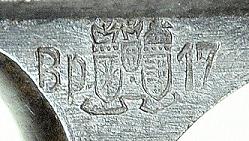 |
Military acceptance mark: 'Bp' (for Budapest), followed by the dual Austro-Hungarian crest and the last two figures of the year of manufacture. The dual crest was used on these guns after Emperor Franz Jozeph's death on 11/21/16. |
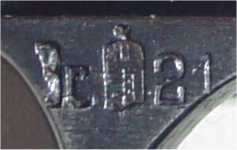 |
This photo shows the acceptance mark of the post-WW1 independent Hungarian Army on the left front side of the trigger guard: 'Bp' (for Budapest), followed by St.Steven's crowned crest and the last two characters are the year of manufacture. |
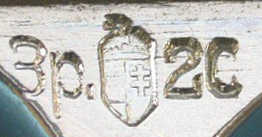 |
Another post-WW1 independent Hungarian Army acceptance mark with better detail of the shield. 'Bp' (for Budapest), followed by St.Steven's crowned crest and the last two characters are the year of manufacture. |
 |
A very rare post-WW1 Czechoslovak Army acceptance mark on the trigger guard: 'S' [Czech Lion] '4'. This Czech military acceptance mark was used between 1919-22, the #4 indicates Military District Hradec Kralove. Probably a war reparation pistol given to Czechoslovakia after WW1. |
 |
The circled 'A' is believed to be a post-WW1 Hungarian acceptance mark. Some sources claim that this is an independent Austrian mark. The serial number of the pistol indicates a cca.1926 Budapest manufacture. The official use of this pistol and the meaning of the circled 'A' are unknown. |
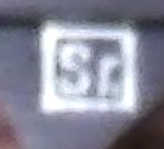 |
The 'Sr' in a square in an unknown post-WW1 Hungarian acceptance mark. This mark can be found on pistols made in 1920-21. The serials are intermixed with standard 'Bp' accepted pistols. Please notify the author if you have some information regarding the 'Sr' marking. |
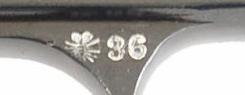 |
An interesting Austrian 1936 acceptance mark. The serial number of this pistol indicates that this pistol was originally part of the 1916 German Contract. It was probably traded or sold to Austria by the Germans. 'Hv-36' Austrian acceptance marks are also reported on Frommer Stops, please send me a photo if you have one. |
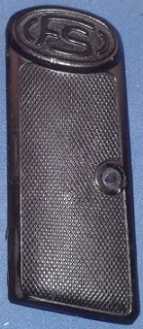 |  |
The early mfg hard rubber grips shown on the far left and the later mfg serrated wood grips shown on the near left, both marked 'FS' |
 |
SERIAL NUMBERING: All Frommers are sequentially serialized, started with Model 1901 and continued through all Stop model changes. Due to lack of available data, these are estimated approximate dates and serial numbers (actual range of numbers reported in parenthesis): 1910 - 1000-3000 1911 - 3000-6000 1912 - 6000-12000 (1st Frommer Stop around 10000) 1913 - 12000-18000 1914 - 18000-30000 1915 - 30000-53000 (51060) (Lw15: 48128) (9mm: 35191 - 49212) 1916 - 53000-133000 (101906-132574) (9mm: 101900 - 110137) 1917 - 133000-208500 (154929-208290) (9mm: 116524, 145617 - 146636) 1918 - 208500-277500 (222469-277493) 1919 - 277500-277500 1920 - 277500-295900 (280776-295812) 1921 - 295900-327000 (295945-326857) 1922 - 327000-335000 (331815-334900) 1923 - 335000-340000 1924 - 340000-345000 1925 - 345000-350000 (346344-349496 nodate, some A-marked) 1926 - 350000-355000 (351617 nodate A-marked) 1927 - 355000-360000 1928 - 360000-363000 1929 - 363000-364000 1916 German Crowned Gothic 'B' or 'D' marked: 53686 - 92542 1916 German Crowned Gothic 'W' marked: 127813 (only 1 reported) 1920-21 'Sr' proofed: 291865, 292414, 299532, 300141, 300825 1921 'VR' proofed: 318540, 320598, 325124Please, send us your Frommer Stop serial number data, so we can correct these serial number ranges. |
Left side markings: FEGYVERGYÁR - BUDAPEST - FROMMER - PAT. STOP CAL.7.65m/m (.32)

Left side markings: FEGYVERGYÁR - BUDAPEST - FROMMER - PAT. STOP CAL.9m/m (.380)

Based on available info, wartime 9mm Frommers appear to be Austrian Eagle marked.
Reportedly, the Frommer Stop can be found without the manufacturer's legend (reason unknown), showing only the military acceptance (Bp.17)
The pistol was also offered commercially in 9mm Short (.380 acp) after 1919, but these lack official markings. The Frommer Stop remained in production until about 1929, and is still relatively common in Central Europe. A 9mm (.380 acp) variant called '39M' was reportedly made for special export order. No 39M examples were reported yet.
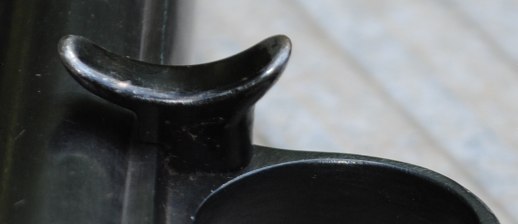
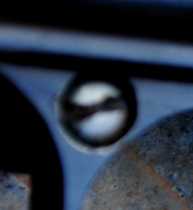 Photos courtesy of Paul Scarlata.
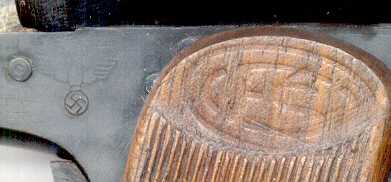 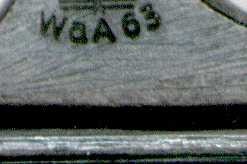 |
WARNING: A few Frommer Stops were stamped with fake Nazi marks (WaffenAmt WaA63). [The WaA63 should be on Mauser K98k rifles.] None of these pistols were Nazi stamped officially. Note: post-war Austrian acceptance such as 'Hv36' or '36' are rare, but correct on these pistols. |
Frommer Stop Field Stripping:
Empty the chamber. Pull out the magazine. Press in the barrel nut retainer (use the corner of the magazine) and unscrew the barrel nut. Release pressure on the
retainer and barrel guide and remove them. Remove recoil spring. Use slotted top of the barrel guide tool: Fit slot over cross lug at end of recoil spring
guide. Push guide rearward, and rotate 90deg. Cock hammer and pull bolt body out to rear. Rotate bolthead clockwise to separate from body. Rotate recoil
spring guide using the barrel guide an additional 90deg to release it from the frame. Push barrel rearward to remove from the frame. Field stripping completed.
For further disassembly, use a small screwdriver to flex ejector spring outward slightly. Crasp spring with a tweezers and slide out rearward; then remove
ejector. Unscrew grip screw and remove grips. Lower hammer. Drive out hammer pin to release hammer with its plunger and spring. Remove grip safety, spring
and lanyard loop by driving out the grip safety pin. Drive out magazine catch pin to free the catch. Bolt catch and trigger with trigger bar can now be
removed by driving out pins. Both disconnector pin and sear pin must be driven out to detach sear. Remove these parts only where necessary, as sear and
trigger springs are difficult to reinsert. Bolt head is staked on both sides of extractor. The mushroomed edges must be filed down to disassemble these
parts and the bolt head restaked on assembly. This should not be attempted without good cause. Reassemble in reverse. Depress bolt catch with tip of
recoil spring guide when inserting barrel so that catch clears barrel threads. Bolt head must be turned so that its smaller locking lug aligns with rib on
bolt body and groove in barrel extension when these parts are reassembled.
Frommer Stop Assembly Drawing and Parts List
Frommer Stop Assembly Drawing
Frommer Stop Sectional Drawing
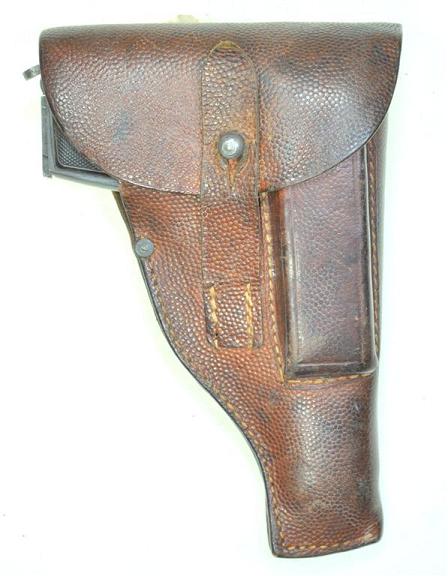
Hungarian made Frommer Stop holster: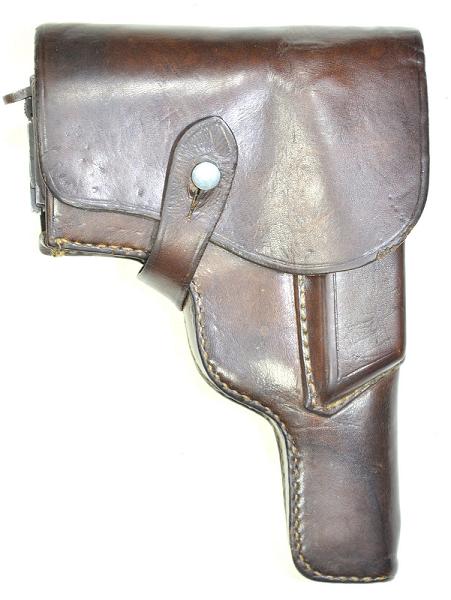
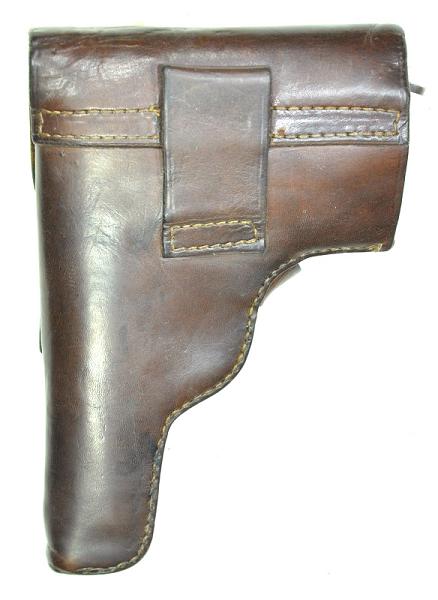
German made WW1 Frommer Stop holster: