


| |
Austro-Hungarian Skoda Machine Guns |
Archduke Karl Salvator and Army Major George Ritter von Dormus patented a new delayed blowback machine gun. It was adopted in 1893 by the Austro-Hungarian
Army and in 1894 by the Navy. One or two machine guns were issued by the Navy to gunboats and patrol boats. The Navy installation weigh 220kg with rotating
stand and 6mm thick shielding. 4000 round of ammunition per gun was the standard issue.
The gun had a fixed barrel, the locking mechanism needed .5 liter of oil for lubrication. The blowback delay was provided by a system of pivoting blocks
and a large coil spring housed in a tube behind the receiver. An optional buttstock was attahable to the coil spring housing. The M1893 was equipped with
a firing rate regulator pendulum with adjustable weight, which oscillated while the gun was firing. The adjustment range was 180-300 round per minute. The
proper function of the pendulum required a sttionary stand installation, which limited the application of the gun to fortresses and ships.
The M1893 was simpler and cheaper to build than the Maxim Machine Gun. Its weekest point was the gravity fed open sided magazine which caused an occasional
malfunction. The first battle test of the machine gun was in 1900 during the Chinese Boxer Rebellion. The Zenta Battle Cruiser provided the defense of the
Austro-Hungarian Embassy in Peking. The defenders were succesful and the Skoda M1893 functioned well. The gun remained in Austro-Hungarian service until
1918, however it was gradually replaced by the more advanced Schwarzlose 1907/12.M Machine Gun.
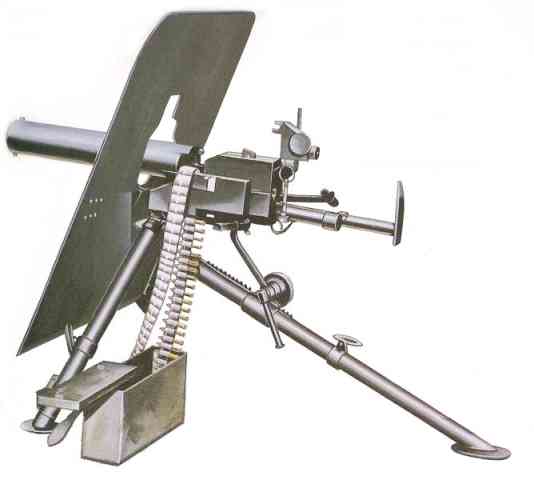 In 1909 Skoda engineers completely redesigned the M1902 again to compete with the Schwarzlose Machine Gun, which was adopted by the Monarchy in 1905.
In the M1909 the rate reducer was eliminated and the breech mechanism was redesigned. A fresh cartridge lubricator was added, which increased the rate of
fire to 425 rpm. The belt-fed system was using a 250-round fabric belt, which entered the left side of the receiver and exited on the top. The belt system
did not completely eliminated the feeding problems.
In 1909 Skoda engineers completely redesigned the M1902 again to compete with the Schwarzlose Machine Gun, which was adopted by the Monarchy in 1905.
In the M1909 the rate reducer was eliminated and the breech mechanism was redesigned. A fresh cartridge lubricator was added, which increased the rate of
fire to 425 rpm. The belt-fed system was using a 250-round fabric belt, which entered the left side of the receiver and exited on the top. The belt system
did not completely eliminated the feeding problems.