


| |
Automatic Rifle Mannlicher Yasnikov M.95 Prototype |
 Mannlicher M.95 Stutzen Rifle originally mady by Steyr, Austria. Altered by Yasnikov, Tula Arsenal, Russia, 1915
Caliber 8x50R M.93 ball
Overall length 1059mm, Barrel length 495mm, Weight 4.3kg (orig. Stutzen 3.6kg)
Muzzle velocity 575 m/s, Max. firing distance 2200m
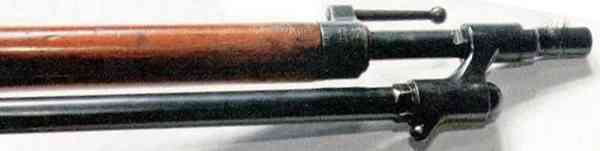
 Yasnikov's 1915 prototype had its gas port 60mm from the muzzle end of the barrel. The external gas chamber and piston was located on the right side of the rifle to allow the rifle sight targeting to stay functional.
A Permamnent metal stop was installed into the stock behind the grip to limit the bolt's rearward movement. The force of the compressed coil spring forced to bolt to load the next round.
Yasnikov's 1915 prototype had its gas port 60mm from the muzzle end of the barrel. The external gas chamber and piston was located on the right side of the rifle to allow the rifle sight targeting to stay functional.
A Permamnent metal stop was installed into the stock behind the grip to limit the bolt's rearward movement. The force of the compressed coil spring forced to bolt to load the next round.
 The M.95 bolt was internally altered, so when the bolthed reached its final locked (rotated) position, it released the firing pin to fire the next round, making the rifle automatic.
A wood sided steel pistol grip was mounted behind the trigger guard. This handle location also protected the user from the fast moving external parts. The
front sight was removed to allow the gas chamber to be installed, a new front sight was installed on top of the gas chamber
 Alhough the Yasnikov's Mannlicher M95/15 Stutzen was completely functional, it was not considerable for military acceptance. The weight of the Stutzen was increased about 20%, the attachments were too bulky,
the side mounted gas piston system made the gun awkward to handle and it caused weight unbalance. The original 5 round magazine was not practical for automatic use. However this design proved the
functionality of the basic theory, but showed that modifying existing weapons will not be practical for military use, and weapon engineers must start with their new automatic weapon designs with the operating
system as internal part of the design. Mannlicher's brilliant bolt design was reused decades later by many of these new designers.
Alhough the Yasnikov's Mannlicher M95/15 Stutzen was completely functional, it was not considerable for military acceptance. The weight of the Stutzen was increased about 20%, the attachments were too bulky,
the side mounted gas piston system made the gun awkward to handle and it caused weight unbalance. The original 5 round magazine was not practical for automatic use. However this design proved the
functionality of the basic theory, but showed that modifying existing weapons will not be practical for military use, and weapon engineers must start with their new automatic weapon designs with the operating
system as internal part of the design. Mannlicher's brilliant bolt design was reused decades later by many of these new designers.
 According to reports, an Italian Luigi Scotti Company worked on a similar alteration of a straight pull rifle to automatic. They arrived to the same conclusion as Yasnikov, that the development of automatic weapons
required new approaches by the inventors. It is worth to mention that Ferdinand Ritter von Mannlicher's genious straight-pull bolt design was the basis of the bolts in modern semi- and fully automatic weapons.
According to reports, an Italian Luigi Scotti Company worked on a similar alteration of a straight pull rifle to automatic. They arrived to the same conclusion as Yasnikov, that the development of automatic weapons
required new approaches by the inventors. It is worth to mention that Ferdinand Ritter von Mannlicher's genious straight-pull bolt design was the basis of the bolts in modern semi- and fully automatic weapons.
Photos by Yuri Yegorov, Russian Weapon Journal.
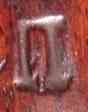 Note: WW1 Russian captured rifles may carry a Cyrillic P (greek PI) stamp.