

| |
Austro-Hungarian Weapons - Mannlicher Rifles and Carbines |

Made by Österreichische Waffenfabriks-Gesellschaft, Steyr, 1886-87
Quantity: 100,000, from which 95,000 were converted to 8x52Rmm as the 'M1886-88'
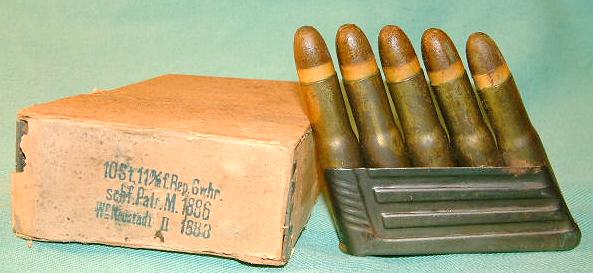
Caliber: M1886: 11x58Rmm (11mm Werndl), M1886-88: 8x52Rmm
Muzzle velocity 440 m/sec with M1877 ball cartridge
Integral clip-loaded box magazine, 5 rounds
Straight-pull bolt action, with a locking bar under the back of the bolt engaging in the bolt-way floor
1326mm [52.2"] overall, 4.52kg [9.9 lbs]
806mm [31.7"] barrel, 6-groove rifling, RH, concentric
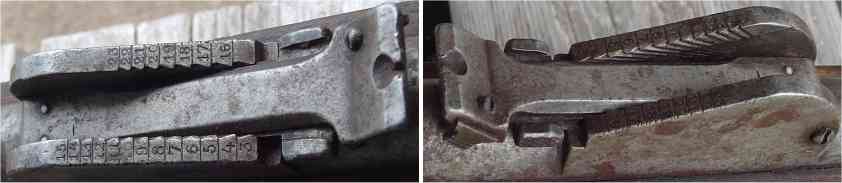 |
Quadrant sight graduated 300 to 1500 schritt Long range volley sight adjustable 1600 - 2300 schritt |
 |
Trials of the 1885-pattern Mannlicher indicated that changes could be made. The M1886 is similar in most respects to the M1885. It is the first of the Austrio-Hungarian service rifles to introduce the feature of the clip dropping out of the bottom of the magazine when the last round is chambered. The 11mm cartridge was improved, with the introduction of this rifle and as a result it had better ballistics than the the M1885. The sights of the M1886, as the M1885 and all other Austrio-Hungarian weapons until after WW1, are graduated in 'Paces' (one pace = 29.53") a term similar to the "Arshin" formerly used by the Russian standard of measurement. The clip-catch was greatly simplified and moved to the lower back of the magazine casing; the leaf-type back sight was replaced by a tangent pattern; the stock was refined and lightened; the cleaning rod under the muzzle was deleted; and the nose cap was redesigned to accept a stacking rod. The M1886 was officially approved on June 20, 1886. Production began immediately - even though concurrent trials had shown an 8mm cartridge to have greater potential. The M1886 was an elegant rifle with a straight-pull bolt and a prominent flat-sided magazine case protruding ahead of the trigger guard bow. It had a conventional sight, though the slider could be extended laterally to the left and used in conjunction with a pin on the left side of the front band for distances up to 2300 schritt. There were two screw-retained barrel bands, and a third doubling as a nose cap to carry the stacking rod beneath the muzzle. A lug on the left side of the nose-cap band received the pommel of the short bladed M1886 knife bayonet. Sling swivels lay beneath the middle band and on the under-edge of the butt. |
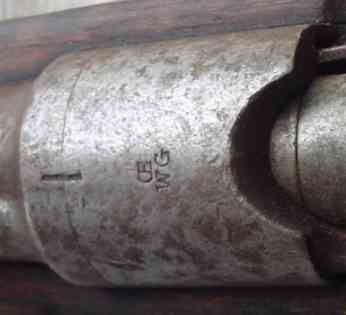
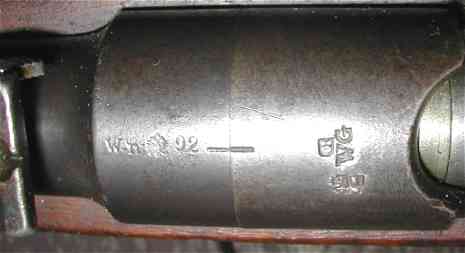 Between 1888-92 95% of the M1886 rifles were converted (rebarreled) to 8x52Rmm under the designation 'M1886-88'.
Note the long thick barrel shank to contain the more powerful cartridge.
Between 1888-92 95% of the M1886 rifles were converted (rebarreled) to 8x52Rmm under the designation 'M1886-88'.
Note the long thick barrel shank to contain the more powerful cartridge.
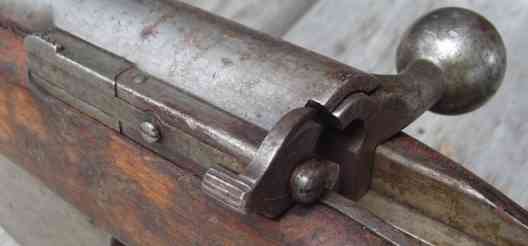
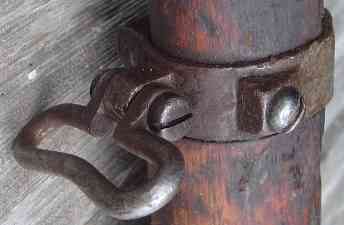
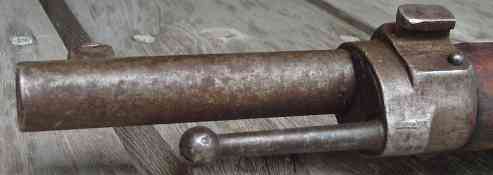 Bayonet lug & stacking hook
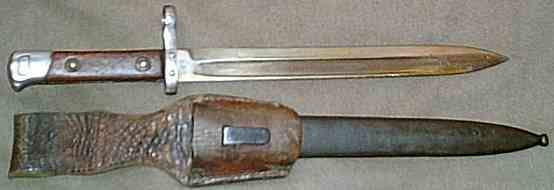 Standard M86 bayonet
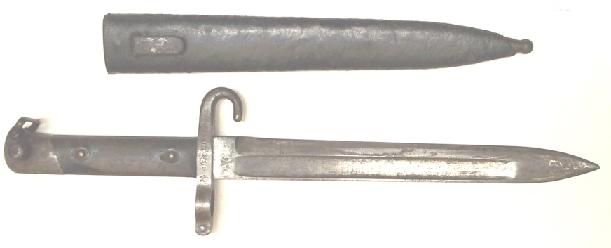 M86-90 NCO bayonet
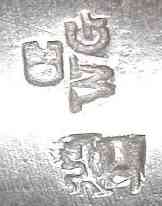 The Czech Lion on an M1886-90 indicates post-WW1 Czechoslovak use
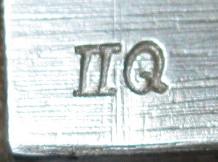
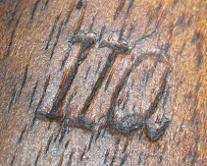
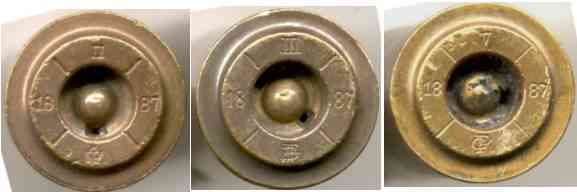
Parts manufactured for these rifles were rejected for the smallest flaws by the military inspectors. The best of the rejected parts still considered safely functional were stamped with 'IIQ'
(2nd Quality) and were assembled into functional rifles. An unknown number of IIQ marked rifles were assembled and these are not included in the 100,000 total manufacture mentioned above.
These rifles were marketed by Steyr at a discount on the international weapon market. Chile and possibly others purchased them. Most of the original unaltered M1886 rifles available are
former Chilean purchased IIQ rifles, due to the fact that Steyr converted 95% of the 11x58mm rifles to 8x52mm for the Austro-Hungarian military.
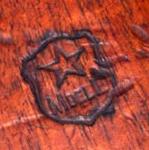 The buttstock marking shield with "Mdele" indicates Chilean use
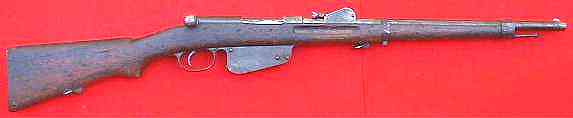 |
Photo courtesy of CollectibleFirearms.com |
An unknown small number of carbines were also manufactured. After 1888 most M1886 carbines were converted (rebarreled) to 8x52Rmm under the designation 'M1886-88'.
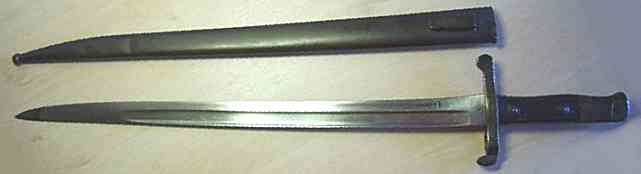 M1886 single edge knife bayonet.